Monday, October 28, 2013

Post Card Art


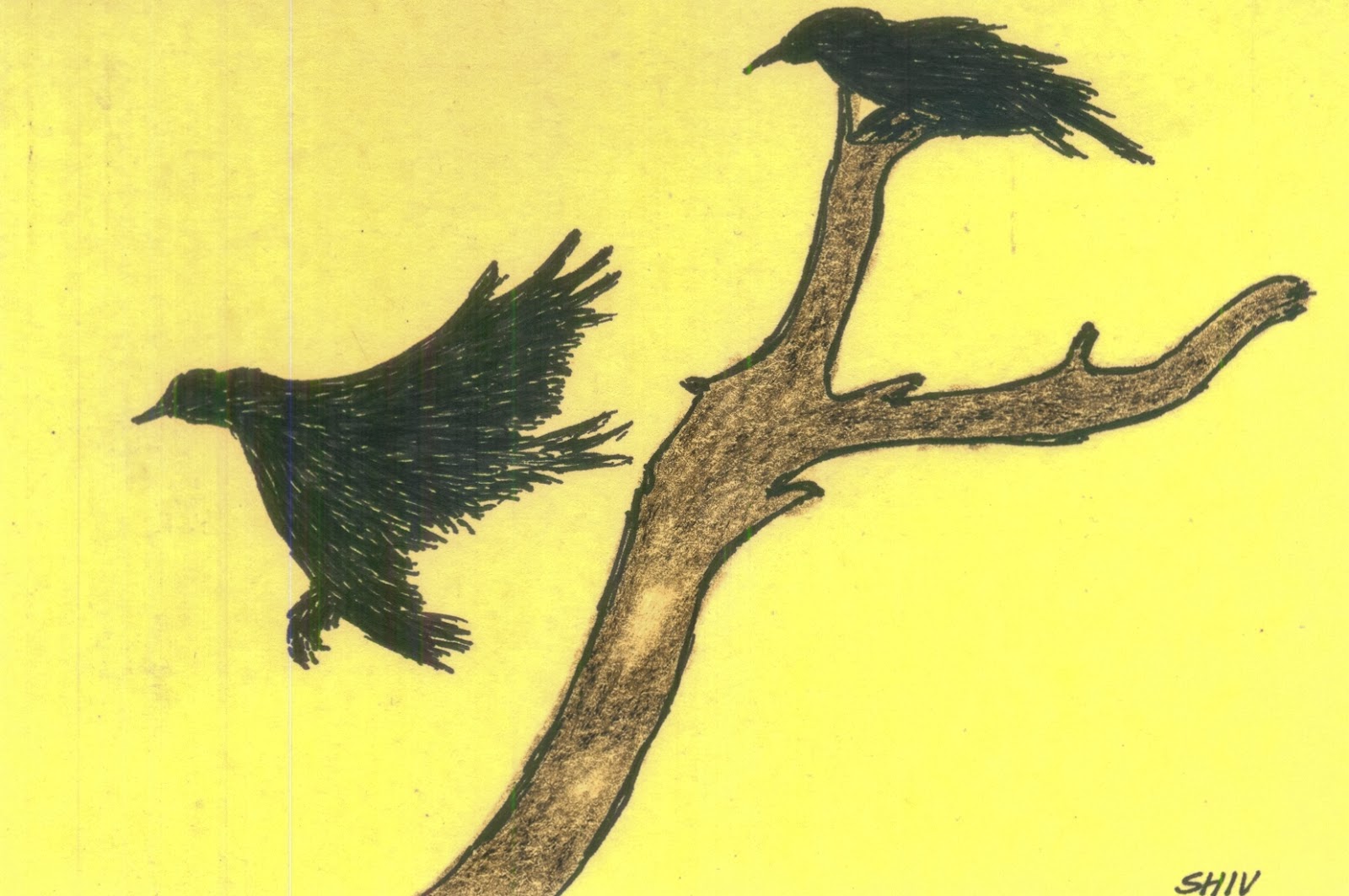
Post Cards are a fun way of communicating. Postage (for hand written post cards) is only 50 paise. Create your own art work or messages on post cards and send them to your near and dear. I was inspired to do so by Russell Menzies and here they are - my first batch, ready to go out!


Wednesday, October 9, 2013

Bommai Kolu

 Bommai Kolu

The old lady stood at the foot of the ladder, arms on her hips, supervising and directing the operations. The little boy sat in front of an open trunk in the attic, un-wrapping the dolls stored inside and handing them down carefully. His two sisters sat at the foot of the ladder, receiving the dolls handed down and dusting them.

The little boy was covered in dust and cobwebs but he was happy. He was allowed to get up into the attic only twice a year, just before Dasara and immediately after. This was something he loved to do. His sisters too were enjoying their chore; chattering away to each other while cleaning and getting the dolls ready to be put on display.

The little boy climbed down and relaxed on the floor watching them. His work was done. It was over to the ladies now.

The display steps, or “kolu padi” as they were known, were not easy to set up. It took a couple of stools, a number of biscuit tins, stacks of books, boxes, planks and the ingenuity of the grand lady to put it all together. She was a past master at this, having done it for the last so many years. She instinctively knew which tins would over go which stools at the two ends, to achieve level and balance. Finally, when the planks were in place and the whole assembly was checked for stability and passed, the steps were covered with a couple of off-white “veshtis”. It was hard toil, but the result was satisfying. The dolls could now be arranged on these steps. Granny took care of the two steps on top while the girls busied themselves with the bottom three. Traditionally, the number of steps was always an odd number.

It would be a few years before the youngest of the family would join his three siblings in Bangalore. Being old enough to climb up the ladder to the attic, he would gleefully join them in the work.

Slowly, the display took shape. At the centre of the top step was placed the “Kalasa” holding a pomegranate surrounded by mango leaves. By its side, the two “marapachi” dolls (traditional dolls, a man and a lady, made of a dark wood and dressed up in colourful costumes) were placed. On either side were displayed the Shiva-Parvati and Rama-Sita sets. On the next lower steps were placed the other sets like the Radha-Krishna-Gopikas and the marriage procession sets. The bottom-most couple of steps were given over to the single dolls, the porcelain statuettes and myriad others collected over the years.

The Dasara display was ready. Neighbours, friends and relatives would be invited to view the display. Every day a different kind of sundal would be prepared and distributed to all visitors.

Some seasons the children would create a “park”. They would spread sand (collected from the neighbouring construction site) on the ground near the display, carefully wet it and sprinkle mustard seeds over it. They would make roads and walkways and place tiny toys at strategic points. A couple of days later the mustard seeds would begin to sprout and the “park” would look green and attractive.

Now the grand old lady is no longer there. The “children” are all much older and two of them have children of their own. But the tradition continues to this day. This year too, if you take some time off to visit our home, you can see the “bommai kolu” display and savour the sundal of the day!

Happy Dasara!
Dasara habbada hardhika shubhashayagalu!


Friday, May 10, 2013

SOLAR CRESCENTS


Solar Crescents


This is a photograph which I took on 16th February 1980 (33 years ago!), in Bangalore, during the solar eclipse which occurred on that day.

I used a Sunflex twin lens reflex camera and black-and-white film to snap this picture.

I remember the eclipse very well. It was a phenomenon we had never witnessed before. Schools had declared a holiday and the people of Bangalore preferred to remain indoors rather than venture out during the eclipse. Those of us who dared to come out were very careful not to look up at the sun.

I had set up a mirror in the garden outside my house to reflect the sun’s image onto a wall inside and we had a live relay of the eclipse!

As I came out to adjust the mirror, I saw a strange and eerie sight on the ground. There was a gooseberry tree right in front of my house. Sunlight filtering through the gaps between the leaves of this tree fell on the ground and appeared as thousands of crescents. The eclipse had created a phenomenon wherein every gap between the leaves of the tree became a pinhole camera which showed the image of the partly-eclipsed sun on the ground. It was a strange and wondrous sight and one not seen commonly.

Luckily I had my camera loaded and ready and could capture this image (the shadow of my head is also seen in the foreground) for posterity!

Wednesday, March 27, 2013

Wednesday, March 20, 2013


Sparrows!

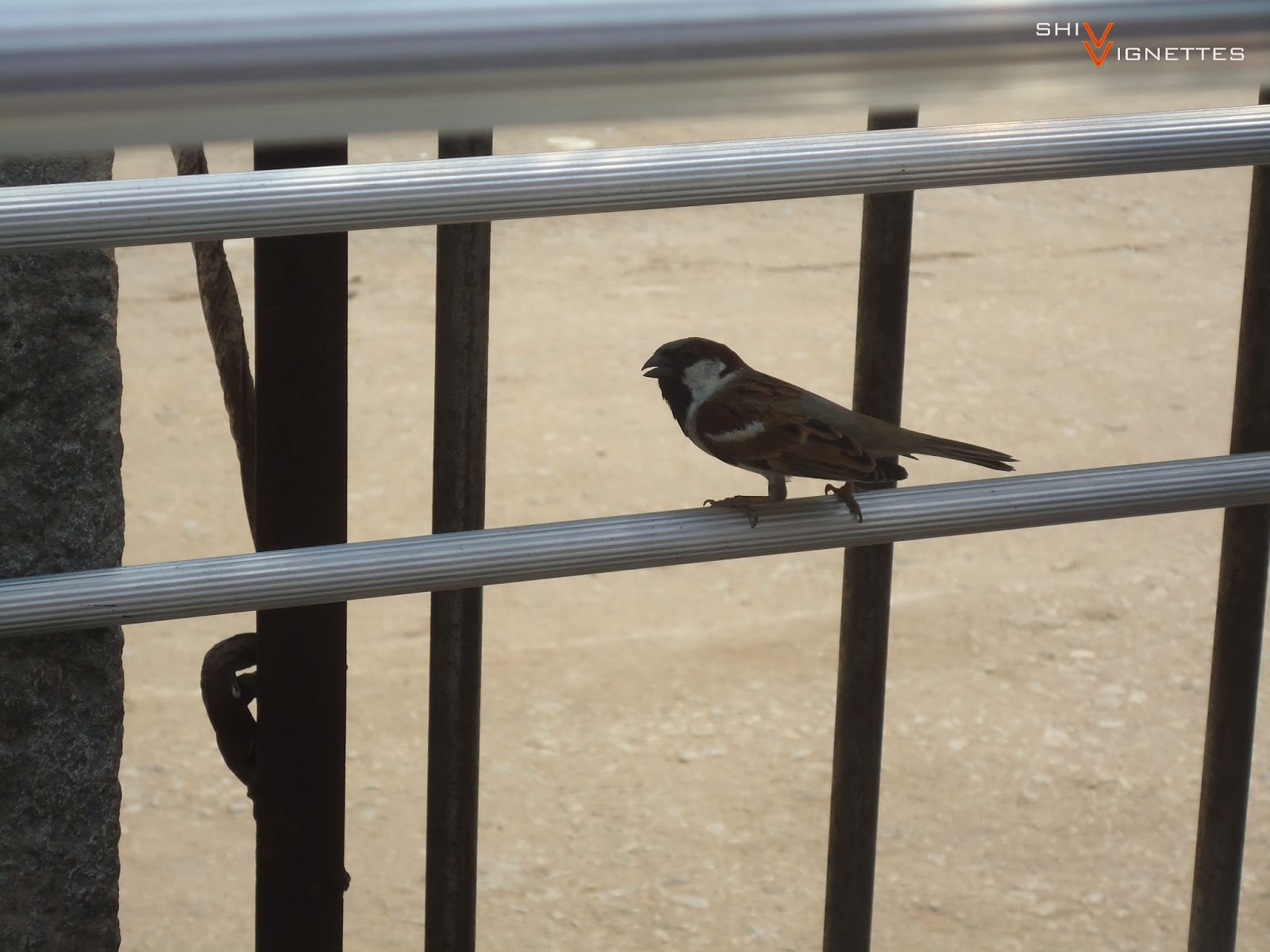
Today is World Sparrow Day. There are very few places in Bangalore where you can see sparrows. One such place is Richards Square, adjacent to Russell Market. It has an open rectangular courtyard with shops on three sides selling kitchenware, old furniture and other stuff. The shopkeepers place bowls of water and sprinkle grains to feed the sparrows. Today being World Sparrow Day, I went there to see my feathered friends and was not disappointed. I stood there for some time, watching the sparrows hop around and listening to their chirps. Thanks to the shopkeepers of Richards Square and people like them, we still have sparrows around us!


Sunday, March 10, 2013

The Road Not Taken

The woods are lovely, dark, and deep, But I have promises to keep, And miles to go before I sleep, And miles to go before I sleep.

The Road Not Taken

by Robert Frost

Two roads diverged in a yellow wood,
And sorry I could not travel both
And be one traveler, long I stood
And looked down one as far as I could
To where it bent in the undergrowth;

Then took the other, as just as fair,
And having perhaps the better claim
Because it was grassy and wanted wear,
Though as for that the passing there
Had worn them really about the same,

And both that morning equally lay
In leaves no step had trodden black.
Oh, I marked the first for another day!
Yet knowing how way leads on to way
I doubted if I should ever come back.

I shall be telling this with a sigh
Somewhere ages and ages hence:
Two roads diverged in a wood, and I,
I took the one less traveled by,
And that has made all the difference.

.

Tuesday, December 18, 2012

Extra Cover!


 As the India-England cricket Test match wound to a dull, boring draw in Nagpur, I couldn’t help but go back several years when India had no pace attack worth its name but relied almost entirely on the guile of its legendary spinners and a few acrobatic fielders.

Who can forget the inimitable Eknath Solkar, who could walk into any team on the merits of his fielding skills alone! A newspaper picture of a prone Solkar with his hands fully stretched out just in front of the batsman and the ball held only by his finger-nails millimeters above the ground remains sharp in my memory and still brings on goose bumps.

Another outstanding close-in fielder was Rusi Surti whose fielding skills were comparable to the very best in the world at that time. He was known as the poor man’s Sobers and many felt that he was the great man’s equal in fielding at least.

Venkataraghavan, one of India’s legendary spinning quartet (and who, after his retirement as a cricketer, became an international umpire), was no mean fielder himself. His favoured fielding position was at Gully, a position which Yuvraj Singh later made his own before injuries forced him to slow down.

But, by far the most “glamorous” fielding position on the cricket field was the region covering Cover Point, Cover and Extra Cover. Captains like to station themselves at these positions, the better to have control over the game. Among the sharpest covers were “Tiger” Pataudi and Bangalore’s own Brijesh Patel. They prowled the cover region like cats stalking their prey and when they pounced upon the ball and sent it screaming back over the stumps, it was pure thrill for us spectators! Of course, the most majestic “super-cat” was Clive Lloyd of the West Indies. Batsmen preferred to stay rooted to their spot and not take a run rather than take on Clive Lloyd! One of India’s most successful captains, Mohammad Azharuddin also liked to field at covers, though he was equally agile at the gully position.

There is a story told about the legendary Colin Bland, the finest cover fielder of his time (and, many believe, of all time). His fielding was so awe-inspiring, that once, when play was held up, he was called upon to entertain the crowd and he kept them riveted to their seats with a breathtaking display. He became such a big star that spectators turned up just to see him field.

In more recent times, South Africa’s Jonty Rhodes made a name for himself as one of the best fielders ever. Some of the other names that come to mind are Paul Sheehan, Derek Randall, Vivian Richards, Roger Harper, Gus Logie, Mark Waugh and Rahul Dravid (the last two at slips).

Sadly, though India has improved by leaps and bounds in other departments of the game, we don’t have any legends on the field any more. Sure, we’ve had a Kaif here and a Yuvraj there, or a Kohli now and a Raina then but they are few and far between. We are no longer a fielding force to be reckoned with. Perhaps the fact that India can no longer boast of a world class spin attack has something to do with this.