Wednesday, November 11, 2015

For the kind information of all Bengalureans

FOR THE KIND INFORMATION OF ALL BENGALUREANS


1.    Power supply is likely to be interrupted on account of maintenance works being carried out on the supply lines somewhere or the other. Our maintenance department is in the dark on account of no prior knowledge. Hence please kindly understand and adjust and be in the dark for a brief period.
2.    Water supply is also likely to be interrupted on account of maintenance works being carried out on the river. The river has been diverted to flow up instead of down for the duration of the maintenance works. Hence please understand, adjust and be without water for a little time only till the river is refilled.
3.    There will be copious amount of rainfall all over the city. This has been specially requested and arranged for our citizens by us as a token of our commitment to providing uninterrupted supply of something at least. However, please note that the falling rain is not under our control and, as such, we are not responsible for any sudden change in the intensity from drizzle to torrential or from torrential to trace.
4.    Collection and disposal of garbage is likely to be affected on account of trashing of all earlier resolutions made by us and snail-like progress of ongoing talks with the kind people of the neighbouring villages who are reluctant to allow their villages to be used as dumping grounds. Our negotiating department which is clueless so far is hard at work trying to figure out what to do and will revert very soon with ideas. Until then, we request you to keep your garbage to yourself, bear the stench and bear with us.
For any garbage-related help, please contact your nearest help-scenter.
5.    Mobile telephone and internet services may be affected on account of no power supply.
6.    Landline telephone services are already affected on some account or the other so we are not announcing it again.
7.    Potholes may re-appear on the roads. Please watch out. We are neither responsible for their appearance nor their re-appearance.
If you find any pothole stretch of more than a kilometre without any road in it, please report to the nearest help-hole.
8.    Mosquitoes have been instructed not to appear in any populated areas but to buzz off. Any mosquito found violating this order will be caught and have its wings chopped off by our Wing Chopping Wing. Meanwhile, we are working on a plan to re-locate all mosquitoes to a special zone created exclusively for them and talks are on in this regard.
However, if you do notice any pesky pest creating nuisance, please mark the spot, identify the culprit and report to your nearest pest help centre.
9.     All other services will function normally.

Your nearest friendly neighbourhood help centre and our help lines have been set up specially for your assistance. However, we do have to warn you that, due to reasons beyond our control, you may find the help centres closed and the help lines not reachable, in which case please bear with us.

We wish you a Happy Deepavali!

Monday, November 2, 2015

A Colourful Dilemna


A Colourful Dilemna

So what colour will it be today? That question was troubling me since early morning and I was in a confused state of mind as I got ready to leave for office. I had had a long weekend with Friday and Saturday being holidays, but now it was time to get back to work. And here I was, undecided about the colour.

For a moment, I ventured to consider Red. Normally I wouldn’t even give a thought to Red, but it was part of my collection and on rare occasions I indulged in it, so I had to give it a chance, albeit a token one. Red was loud, a colour to be wary of, a colour that would stand out like the dickens and would refuse to simply blend in. No, I decided, Red wouldn’t do, at least not today, not at work.

My thoughts moved on to Turquoise. Now here was a vibrant colour, if ever there was one, a colour that made me think of the Mediterranean and of Zorba; a friendly, bright colour that made me smile broadly. But I did not want to smile broadly today; I wanted to look stern and businesslike. Turquoise may be a bright option but Turquoise was not the right option.

From Turquoise to Green was a natural progression. Green had a certain mysticism, a magnetism, a power to draw the eye towards it, a power that could captivate. Green, it would be, I thought for a moment. Or would it? I dillied. I dallied. I stood first on one foot, then on the other, trying to coax my mind to say yes to Green. But my mind was a silly thing with a mind of its own. It did not give Green the green signal. So, out of the reckoning went Green. I was back to Square One, my mind still not made up.

Square One seemed to be made up entirely of some black substance and it made me see light. Black was my all time favourite colour. I always liked to say that Black lent character to any character who leant towards Black. Black unequivocally conveyed the impression that I was upright, straight. Ergo, I was leaning towards Black when I realized that I had been leaning towards it all of last week and the week before that too, so much so that I had begun walking in a slant and tall buildings began to look like leaning towers. It dawned on me that Black was leaning on me a bit too hard. I shook all thoughts of Black away from my mind and decided to look for some other colour.

Briefly I flirted with Violet, but only briefly. Violet was, well, Violet and too royal for my liking. I must confess that now and then I like to think of myself as the man who would be king and go all Violet. But today I would be a commoner and, er, no thank you, no Violet today. Thanks but no thanks.

If Violet was too royal, then Brown was too earthy. Did I want to be earthy? Not me. Who on earth wants to be earthy? I may be a commoner today, but I was not an earthy commoner. That’s a bit too common. Hah! No brown for me, sahib!

Thinking of royal made me think of Blue. Now here’s a colour that was good for royalty and yet was common enough for commoners, a colour that was easy on the eye and did not draw any attention towards itself. But after a moment’s hesitation I discarded blue. Tcha! No easy-peasy on the eyes-pies for me.

I was beginning to think I may not be able to go to work when I was struck squarely between my eyes rather hard by the realization that I hadn’t given a thought to a good old colour which had enough royalty, a good dose of uprightness, oodles of character and, if you look carefully, even a bit of friendliness around the edges. There it was, sitting right in front of me all along.

With deep reverence I pulled the bottle of Blue-Black ink towards me and, gingerly opening my fountain pen, filled it triumphantly. I was ready to go. In fact, I was raring to go! No horses could stop me; no chains could hold me back. Office, here I come, armed with my favourite fountain pen filled with my favourite Blue-Black ink.


© Shiva Kumar

Wednesday, October 21, 2015

Monday, October 19, 2015

Sunday, September 13, 2015

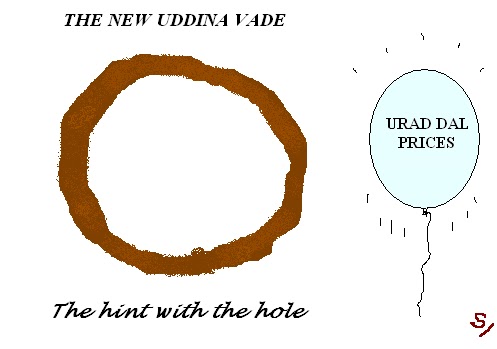
Gunpowder


GUNPOWDER
( Dhamakedaar Pudiya in Hindi* / Kadale Pudi in Kannada / Pappu Podi in Telugu / Paruppu Podi in Tamil )

*I do not recall the name for this in Hindi, so I am calling it Dhamakedaar Pudiya meaning “explosive powder OR powder which causes a bang”!
  
 ~

A fiery dry powdery concoction that can reduce even kings to tears. 
Its chilli power can knock you silly but its diehard fans (and they are legion) swear by it.
The uninitiated simply swear when it touches tongue.

The Name: 
Its Kannada name is a friendly “Kadale Pudi”, its Telugu name is a mild-sounding "Pappu Podi" and its Tamil name is an equally innocuous "Paruppu Podi" but it is universally known by the more user-friendly "Gunpowder".

Can be had mixed with hot plain white rice with dollops of ghee (clarified butter) or as an accompaniment to sambar and rice (again with generous helpings of ghee, for ghee is the facilitator of smooth passage). 
It increases the fire power of any dish it caresses.
Its bark is like a storm warning, Force 7 to 10, depending upon the chilli.
Its bite is worse than its bark.
In fact, its bite is like a spark.

The Makings:
Split Chick Peas - Chana Dal / Kadale Kaalu / Senagalu /  Kadalai Paruppu (Cd) - 3 tbsp
Red Gram (Pigeon Pea) - Tur Dal / Togiri Belae / Kandi Pappu / Tuvaram Paruppu (Td) - 1 tbsp
Black Gram - Urad Dal / Uddina Belae / Mina Pappu / Ulutham Paruppu  (Ud) - 3 tbsp
Sesame seeds - Til / Ellu / Nuwulu / Ellu, (Ss) - 3 tbsp
Dry Red Guntur Chilli* - Lal Mirchi / Ona Menasinakai / Yendu Mirchi / Milagai Vatthal  (Rc) - 5 
Asafoetida* - Hing / Ingu / Ingulu / Perungayam  (Af) - 1 pinch

(OR Garlic - Lassoon / Bellulli / Vellulli / Vellai Poondu - 1 clove, as alternative to Asafoetida)

Cooking Oil (Oi) – Khana Pakaane ka Teyl / Adige Ennae / Vanta Noona / Samayal Ennai - 1 tbsp
Sugar (Su) - Cheeni / Sakkarae / Sarkara / Sarkarai - 1 tsp, optional, to reduce the Fear factor and the Tear factor, not to mention the Rear factor!
Salt (Sa) - Namak / Uppu / Uppu / Uppu - to taste

*The Chilli:
The dry, red chilli may be of any of the following varieties:
   Guntur Yendu Mirchi for Heat, produces Big Bang effect on Gunpowder
   Byadgi Ona Menasinakai for Colour, produces Small Bang
   Salem Gundu Milagai for moderate colour, produces moderate whimper
   Kashmiri Mirch (or Degi Mirch) for mild fruity flavour, produces mild simper

The Guntur is recommended for maximum incendiary effect but you may opt for any of the above candidates depending upon your own fire fighting capabilities.

The Hing Thing:
Asafoetida.
Great spice.
Of Iranian origin, now proudly Indian.
Has a strong, pungent odour but in cooked dishes gives a smooth, full flavour.
Used in tiny quantities, its aroma and flavour can lift food to a different level.
Is called "Devil's Dung" by lesser fans and "Food of the Gods" by greater fans.
Use too much of it and you may need an exhaust fan.

The Method:
Pour the cooking oil into a vaanali * and heat till medium hot.
Add all the makings (except sugar and salt) and lightly fry, stirring all the while.
Remove, add sugar and salt and grind to a fine powder.
Store in an airtight container away from children, pets, poets and senior citizens.

*The Vaanali: Wok / Kadaai (Kadahi) / Baanali / Baandli / Vaanali
Yeh kya hai re? Yeno idu? Yemi ra idi? Enna da idu?
The vaanali is nothing but a kadaai or a wok, the domestic model varying from about 9" to about 12" in diameter.
Some variants are provided with two ears to handle.
Traditionally made of iron (not just the ears but the whole vessel), but nowadays all sorts of pretenders are available in the market.

Vaanali makers are a special breed. 
Some of the shops in Tiruchirapalli where I found the best vaanalis, kadaais or woks, while hunting for the best paalgova (sweetened and thickened milk or khova), are
Akasha Vaanali 
Tiruchi Vaanali Nilayam
The Kadaai Kadai
The Wokky Tokky Shoppy
The Shop While You Wok and
The Wok While You Tok
You can shop till you droop but don't drop the vaanali (or the kadaai or the wok) on your toe or you won't be able to wok, er.., I mean, walk.

The Test:
The test is in the taste.
Take one pinch, put it on the tongue, preferably your own tongue, not someone else's, stand still and experience.
There will be an initial floating sensation.
This will be followed by a Twang! and a Bang!! 
The bang may be Big or Small, or a Whimper or a Simper, depending on the chilli.

The Warning:
Statutory Warning: DO NOT BREATHE WHILE TESTING.
Breathing may produce Big Bang. Or Small Bang. Or Whimper. Or Simper. Depends.

The Reaction:
Oi + Heat + 3Cd + 1Td + 3Ud + 3Ss + 5Rc + 0.1Af + 0.1Su + Sa + Air = BIG BANG! (Or SMALL BANG! Or WHIMPER! Or SIMPER! Depends.)

The Trial:
Take one cup of hot cooked rice on a plate.
Add one liberal teaspoon of ghee.
To be on the safer side, add one more liberal teaspoon of ghee.
Sprinkle two teaspoons of gunpowder over the rice. Be liberal at your own risk.
Keep nose away while sprinkling (the nose should not get even an inkling of the sprinkling or it may lead to calamity in the twinkling of your eye).
Mix well.
Eat.
Enjoy.
Wipe nose and eyes frequently.
Keep water handy.

The End
That's all.
Samaapth.
Mukhthaaya.
Selavu.
Mutrum.
Khel khatam.
Naatak bandh.
Curtains.
Finis.
La fin.

El fin.
Finito.


- Sib Bahut Dur


© Shiva Kumar


Saturday, September 12, 2015

KAAPI


KAAPI

Coffee: a drink made by brewing coffee beans which are berries of coffee plant. One of the most popular beverages in the world, it is said to have been smuggled out of Yemen in 1670 by Sufi Saint Baba Budan and planted on the slopes of a hill in Chikmagalur district of Karnataka. This hill later named Baba Budangiri after him. Now coffee is part of the South Indian culture. Who knows what we might have been drinking if the Baba had not brought coffee to South India? Extract of roasted and ground tamarind seeds, perhaps.

Coffee powder: Made from coffee beans roasted and ground. Sometimes it is blended with roasted chicory powder (the root of the chicory plant is a coffee substitute and additive) to enhance flavour and colour though a purist would scoff at chicory. Different pure coffee varieties like Arabica and Robusta and coffee-chicory blends available in the market. Custom blending is also done by many retailers to suit your preference.

In the olden days, roasting and grinding were done at home. Every South Indian home had a mini roasting cylinder in which coffee beans were placed and the cylinder rotated over a charcoal fire. A week’s requirement would be roasted and stored. A mini grinder was fixed to the kitchen shelf in which one cup-full of beans, enough for the day’s consumption, would be ground every day.

Coffee Decoction: The coffee liquor or essence or decoction is extracted by passing boiling water through a layer of coffee powder placed in a filter. For South Indians, this is a ritual which has to be learned and perfected, no matter what.

Kaapi: South Indian for coffee.

Tumbler-Dabara (or davara): A tumbler is a drinking glass, a straight or slightly tapered cylinder without a handle. May or may not have a rim. South Indian coffee tumblers paired with dabaras have rims. A dabara (or davara) is a shallow cylinder with a flat rim. Commonly made from Stainless Steel or ‘Eversilver’. ‘Eversilver’ is Tamil for stainless steel, probably derived from a popular brand name in the good old days. Together, tumbler and dabara make good style statement. Together, with good strong filter coffee inside the tumbler, makes for good hospitality.

South Indian filter kaapi is best had strong, i.e., ‘first’ decoction (decoction obtained from the first filtration; many homes, which don’t place much importance on good coffee or civil hospitality, have a second and even a third filtration), mixed with freshly boiled milk, a spoon of sugar added to just mask the bitter taste, in an ‘Eversilver’ tumbler-dabara.

1.       Wash and clean both tiers of two-tier Eversilver coffee filter and the tamper. Let them sparkle.
2.       Top tier is for loading the makings. Bottom tier collects the decoction. Tamper is for tamping.
3.       Wash and clean Eversilver tumbler and dabara. Let them shine.
4.       Tumbler-Dabara is like cup-saucer, but better and more versatile. Very nice. Stylish.
5.       Stack top tier over bottom tier.
6.       Boil water, enough quantity to fill top tier of filter.
7.       Fill about one-fourth or one-third of top tier of filter with roasted and ground coffee powder.
8.       Tamp coffee powder down lightly with perforated-disc-with-stem tamper provided with filter.
9.       Pour boiling water over coffee powder till it fills up top tier.
10.   Give filter smart tap with a spoon to start filtering process. Close filter lid.
11.   Pick up newspaper, read headlines backwards. Or count down from 300. Time.
12.   Decoction ready.
13.   Pour decoction from bottom tier of filter into tumbler. Fill about 25.40 mm from bottom.
14.   Top up with freshly boiled milk, steaming hot. Fill up to top, leaving 19.05 mm to 38.10 mm free for any “adjustments” like more milk, more decoction, more froth, etc.
15.   Add sugar.
16.   Place tumbler in dabara.
17.   Coffee ready for backing and forthing.
18.   Pour coffee from tumbler to dabara and back and forth to cool it and to dissolve sugar.
19.   Taste. Do necessary adjustment.
20.   For more froth, increase distance between tumbler and dabara while backing and forthing.
21.   To stretch the coffee, take tumbler farther and farther away from dabara as you pour.
22.   Keep watchful eye while stretching. Keep mop handy.
23.   Enjoy.
24.   Wash and clean tumbler and dabara when finished.
25.   Mop floor if necessary.

(India changed over to the Metric system about half-a-century ago, throwing the whole country into a state of utter confusion for some time before the good citizens re-collected their wits and started inventing conversion tables. But the old British units are still being used for measurements. For instance, the amount of rain falling on a particular day, any day, whether Tuesday or Friday does not matter, is generally measured and spoken of in inches. Some people also measure heavy rain in terms of domestic animals and buckets. Levels of certain liquids, esp. of the life-saving variety, poured into glasses, are measured in terms of fingers, such as two fingers of this or a healthy dose of four fingers of that. Coffee decoction falls under the beverage category, second only to life-saving, and its measure is generally in “inches”. But I am trying to be properly metric in these matters and have therefore indicated the dabara diameter, levels of decoction and milk in tumblers, etc. in millimeters (mm), correct to second decimal place. For those who are wary of decimals and chary of calculating up to second decimal places, 25.40 mm equals one inch. 19.05 mm is three-fourths of an inch. 38.10 mm is one-and-a-half, 76.20 mm is three and 101.60 mm is, what else, four inches. I hope I made myself clear. Now let me go. I have to inch along to another article.)

-          © Shiva Kumar, September 2015

Sunday, September 6, 2015

Train Songs


Recently I was listening to the song “Mere sapnon ki rani…” from ‘Aradhana’, the film which catapulted Rajesh Khanna to superstardom and made him the very first (and the only) “Phenomenon” in the Hindi film industry. The song shows Sharmila Tagore, at a window seat of a coach of the Darjeeling Himalayan Railway “Toy Train” reading, trying to, or pretending to read, Alistair Maclean’s “When Eight Bells Toll” and Rajesh Khanna crooning away, in a Jeep driven by Sujit Kumar, running parallel to the train. Those who know this place say the locale for the song was the Batasia Loop near Darjeeling in the Kurseong-Darjeeling section.

The music in this song, of the shrill flute mimicking a steam engine’s whistle and the rhythmic "hiss hiss hiss" in the background reminding you of the pistons pumping away and the steam escaping in little puffs, the accordion emphasizing the rhythm … one doesn’t have to have seen the film to visualize the train chugging along. Totally romantic, I should say. One almost forgets the Jeep (in itself a vehicle much favoured by the Hindi film industry for picturising songs in) which rolls along parallel to the train. A composition made for the train, this song.

Another equally romantic song and one which also became a superhit is "Hum dono do premi duniya chhod chalein" from the Rajesh Khanna-Zeenat Aman starrer ‘Ajnabi’. The duo is on bales of hay stacked on the flatbed wagon of a goods train (the easier to hop on and off), singing away with abandon. I don’t remember whether they were running away, escaping or just going for a ride. Rahul Dev Burman, the composer, has paced this song so beautifully that the melody and the beat create the mood effortlessly.

My thoughts now go to another song, “Gaadi bula rahi hai …” (from ‘Dost’), where the train, as it chugs along, becomes the exemplar for the singer to dole out the philosophy of life. The train is adviser personified and every movement is a piece of advice. This song, featuring Dharmendra, was picturised on the then Simla Toy Train running from Kalka to Simla (now called Shimla) This has become an iconic song.

And no doubt you have heard the song "Rail gaadi" sung for children by Dada Moni Ashok Kumar in the film ‘Ashirwad’ which remains a firm favourite in that category even today. The way he reels off rhyming names of places in pairs in that breathless style of his is simply captivating. This is “rapping” of the highest order! The song was written by the irrepressible Harindranath Chattopadhyay and the music was scored by Vasant Desai.

Two Rahul Dev Burman creations are among my favourites; "Dhanno ki ankhon mein raat ka surma..." from ‘Kitaab’ and "Hoga tumse pyara kaun..." from ‘Zamane Ko Dijkhana Hai’. In the first one, the locoman (or engine driver, in my childhood parlance) romanticises about Dhanno which is the name of his girlfriend who lives in a village along the train's route. But to me, as I listen to the song, the engine takes on a life of its own and could very well be the Dhanno in the song. In the second song, Rishi Kapoor tries to pacify an angry Padmini Kolhapure, both sitting atop a railway carriage as the train chugs along. As the track meanders through the scenic countryside, so does the tune, transporting the listener to an idyllic land far, far away.

Then there is the Sachin Dev Burman composition from the film ‘Kala Bazaar’ in the voice of the inimitable Mohammad Rafi: "Apni to har aah ek toofan hai...". What a melodious song this is, and how beautifully picturised! There is only the barest hint that this song is picturised in a train but that is more than enough to make you go along for the melodious ride!

There is a certain something about the chugging sound made by a steam engine which cannot be replicated by any other. The modern day diesel engines and electric locomotives may have awesome pulling power but they cannot hold a candle to the romanticism of yesteryear’s steam engine.

Indeed, I think any composer would be proud to have a train song in his repertoire.


(Disclaimer: All the links to the “train songs” given below are taken from youtube. All rights to these songs vest with the respective Copyright owners and no copyright infringement is intended. These links / songs are posted here purely for personal entertainment and not for any commercial purpose.)

1.     Mere sapnon ki rani
– ARADHANA  –  Kishore Kumar / Anand Bakshi / Sachin Dev Burman

2.     Hum dono do premi duniya chhod chalein
– AJNABI – Kishore Kumar, Lata Mangeshkar / Anand Bakshi / Rahul Dev Burman 
http://www.youtube.com/watch?v=d7ABnmJETxE

3.     Gaadi bula rahi hai
– DOST – Kishore Kumar / Anand Bakshi / Laxmikant-Pyarelal

4.     Rail gaadi
– ASHIRWAAD – Ashok Kumar / Harindranath Chattopadhyay / Vasant Desai 
http://www.youtube.com/watch?v=D8IJKI0vmQE

5.     Dhanno ki aankhon mein
– KITAAB – Rahul Dev Burman / Gulzar / Rahul Dev Burman

6.     Hoga tumse pyara kaun
– ZAMANE KO DIKHANA HAI – Shailendra Singh / Majrooh Sultanpuri / Rahul Dev Burman  http://www.youtube.com/watch?v=iaFmNil_xYo

7.     Apni toh har aah ek toofan hai
– KALA BAZAAR – Mohammad Rafi / Shailendra / Sachin Dev Burman