
A little bit of this and a little bit of that
Wednesday, March 27, 2013


Wednesday, March 20, 2013
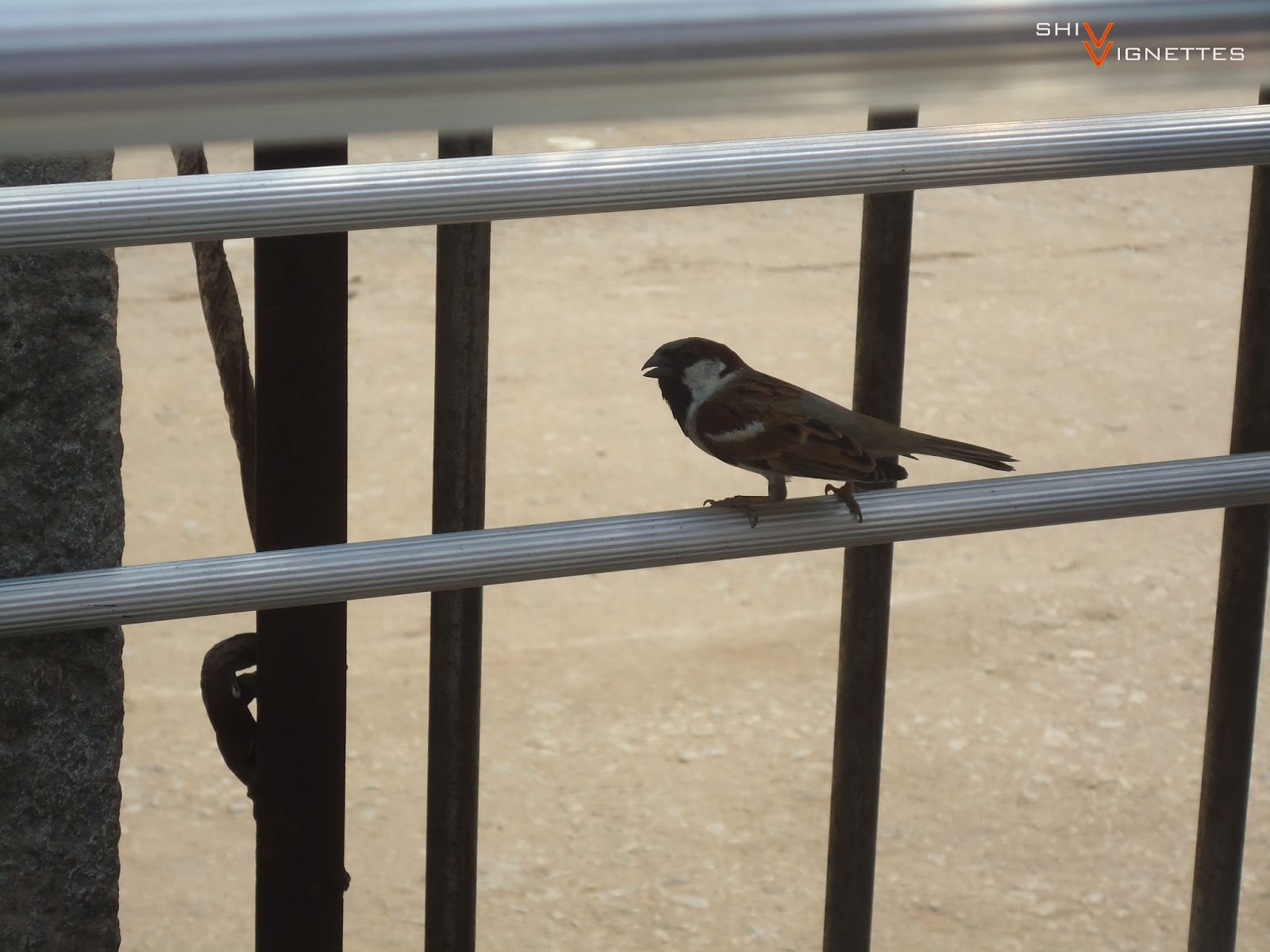
Sparrows!
Today
is World Sparrow Day. There are very few places in Bangalore Richards Square Richards Square



Sunday, March 10, 2013
The Road Not Taken
 | ||
The woods are lovely, dark, and deep, But I have promises to keep,
And miles to go before I sleep,
And miles to go before I sleep.The Road Not Takenby Robert Frost
Two roads diverged in a yellow wood,
And sorry I could not travel both And be one traveler, long I stood And looked down one as far as I could To where it bent in the undergrowth; Then took the other, as just as fair, And having perhaps the better claim Because it was grassy and wanted wear, Though as for that the passing there Had worn them really about the same, And both that morning equally lay In leaves no step had trodden black. Oh, I marked the first for another day! Yet knowing how way leads on to way I doubted if I should ever come back. I shall be telling this with a sigh Somewhere ages and ages hence: Two roads diverged in a wood, and I, I took the one less traveled by, And that has made all the difference. | . |
Tuesday, December 18, 2012
Extra Cover!
As the India-England
cricket Test match wound to a dull, boring draw in Nagpur ,
I couldn’t help but go back several years when India
Who can forget the inimitable Eknath Solkar, who
could walk into any team on the merits of his fielding skills alone! A
newspaper picture of a prone Solkar with his hands fully stretched out just in
front of the batsman and the ball held only by his finger-nails millimeters
above the ground remains sharp in my memory and still brings on goose bumps.
Another outstanding close-in fielder was Rusi Surti
whose fielding skills were comparable to the very best in the world at that
time. He was known as the poor man’s Sobers and many felt that he was the great
man’s equal in fielding at least.
Venkataraghavan, one of India
But, by far the most “glamorous” fielding position
on the cricket field was the region covering Cover Point, Cover and Extra
Cover. Captains like to station themselves at these positions, the better to
have control over the game. Among the sharpest covers were “Tiger” Pataudi and Bangalore West Indies . Batsmen
preferred to stay rooted to their spot and not take a run rather than take on
Clive Lloyd! One of India
There is a story told about the legendary Colin
Bland, the finest cover fielder of his time (and, many believe, of all time).
His fielding was so awe-inspiring, that once, when play was held up, he was
called upon to entertain the crowd and he kept them riveted to their seats with
a breathtaking display. He became such a big star that spectators turned up
just to see him field.
In more recent times, South Africa
Sadly, though India India
Sunday, December 11, 2011
Bangalore, the great melting pot!
Technology has shrunk the world and made it a smaller place. People are migrating from their home towns to other towns and cities and even other countries to study or to work or simply to settle down into their retired lives.
As for me, I’ve been rooted to Bangalore Gujarat where I was born. The only languages I knew then were Gujarati and Tamil. In Bangalore
This great mixing is taking place not just with the languages, but with food as well. You can go to any of Bangalore
Of course, if you are one of the “driven” types, you can sample the “gobi motor”, the “motor masala” or the “aloo motor”! Dumbstruck, are you? Wait till you check out the “dumb biryani”!
Tuesday, November 29, 2011
My encounter with Bhoot Jolokia!
11-11-11
My encounter with Bhoot Jolokia:
One small bite...
1. The first couple of seconds, nothing happens
2. Then a sort of warmth starts at the point of contact and spreads, increasing in both reach and heat
3. By the fifth second the inside of my mouth feels like it caught fire and my tongue is getting scorched
4. By the eighth second the hiccups start
5. Speech becomes difficult
6. The heat spreads to the brain (“bheja fry”?) and stays there
7. It is a while before sanity returns
Thankfully, I escaped with just a heat stricken tongue as the bhoot retreated
I looked at my watch; it was 11:30pm, so all this must have started at 11:11:11
My encounter with Bhoot Jolokia:
One small bite...
1. The first couple of seconds, nothing happens
2. Then a sort of warmth starts at the point of contact and spreads, increasing in both reach and heat
3. By the fifth second the inside of my mouth feels like it caught fire and my tongue is getting scorched
4. By the eighth second the hiccups start
5. Speech becomes difficult
6. The heat spreads to the brain (“bheja fry”?) and stays there
7. It is a while before sanity returns
Thankfully, I escaped with just a heat stricken tongue as the bhoot retreated
I looked at my watch; it was 11:30pm, so all this must have started at 11:11:11
Sunday, August 14, 2011
I could have been ...
I could have been ...
... a banker, but the idea just did not interest me.
... a miner, but I did not dig the job.
... a photographer, but the idea did not click.
... a chauffeur, but I did not have the drive.
... a parachutist, but I let the idea drop.
... a building contractor, but I preferred sight-seeing to site-seeing.
... a banker, but the idea just did not interest me.
... a miner, but I did not dig the job.
... a photographer, but the idea did not click.
... a chauffeur, but I did not have the drive.
... a parachutist, but I let the idea drop.
... a building contractor, but I preferred sight-seeing to site-seeing.
Subscribe to:
Posts (Atom)